

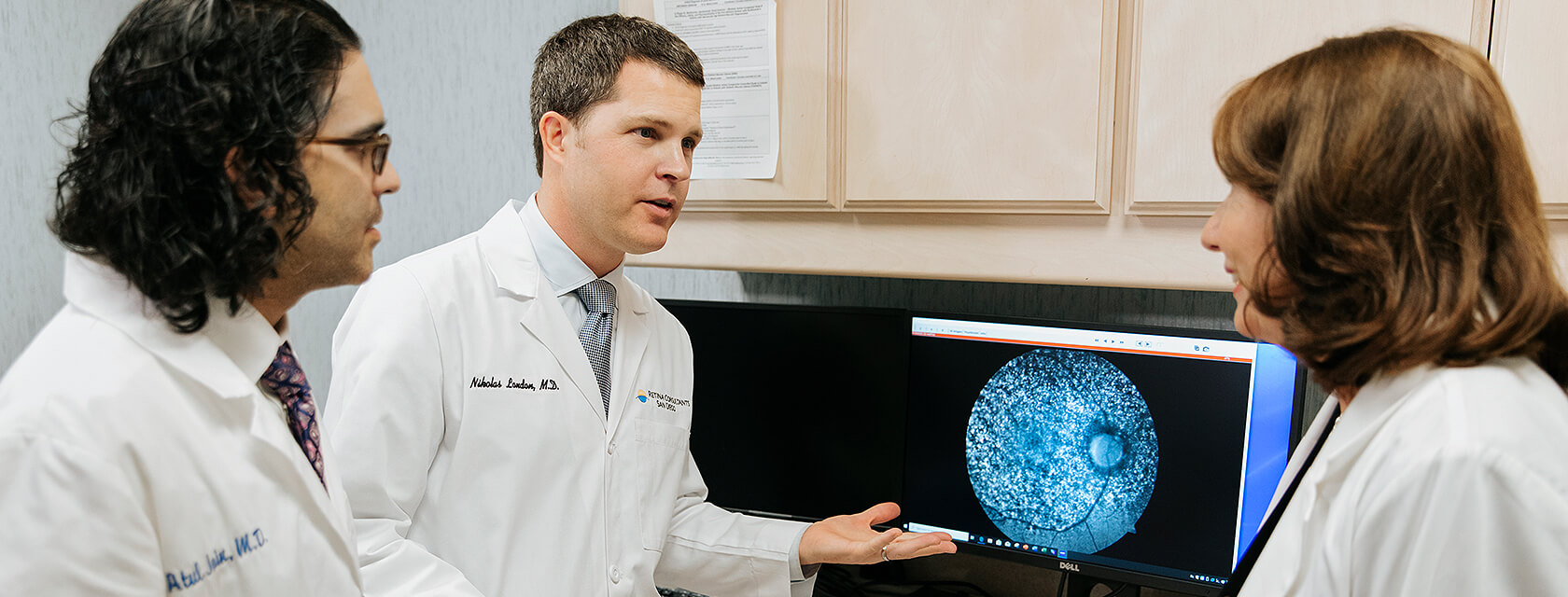
Actively Enrolling Clinical Trials
Wet Macular Degeneration
Wet age-related macular degeneration (Wet AMD) is characterized by the development of irregular blood vessels beneath the macula. Left untreated, these vessels can permanently damage the delicate retinal tissue. Prior to approximately 2005, effective treatment options were limited, often resulting in significant vision loss for affected patients.
However, thanks to clinical trials conducted in the early 2000s, we now have highly effective, minimally invasive, and nearly painless treatments. Unfortunately, these treatments require frequent repetition—approximately every 10 weeks—to maintain vision. This can be burdensome for both patients and caregivers.
Excitingly, we are actively collaborating in the development of the next generation of treatment options. These include longer-lasting and even more effective molecules, as well as groundbreaking gene therapy that holds the potential to essentially cure some patients.
Clinical trials offer hope during these transformative times. Below, we highlight some of the trials in which we participate and that are available to our patients. If you believe you, a friend, or a family member might be a suitable candidate, please don’t hesitate to reach out to our research team at [email protected].

4-FRONT 1
4D Molecular Therapeutics (Emeryville, CA)
4FRONT-1 is a Phase 3 multicenter, randomized, double-masked, aflibercept 2 mg (Q8W) comparator-controlled study of intravitreal 4D-150 in wet AMD.
PI: Michael Ammar, MD
Status: Active and enrolling
NIH registration: Clinicaltrials.gov
Sponsor website: 4D Molecular Therapeutics
Contact: [email protected]
Dry AMD & Advanced Dry AMD (Geographic Atrophy)
Dry age-related macular degeneration (AMD) is prevalent among patients over 60 years old. It is characterized by the accumulation of small deposits, akin to cholesterol, beneath the macula. While these deposits are generally benign, a subset of patients with dry AMD progresses to an advanced stage known as geographic atrophy (GA). In GA, the tissue directly beneath the retina (retinal pigment epithelium) begins to deteriorate, resulting in dense blind spots that gradually expand over time.
For affected patients, everyday tasks become formidable challenges. Reading, driving, and even recognizing familiar faces can become increasingly difficult. However, ongoing research sheds light on the disease process, and numerous molecules are under evaluation to slow down vision loss in these patients. Treatment options include painless eye injections, systemic subcutaneous injections, and cutting-edge gene therapy.
Our unwavering commitment is to help develop effective treatments that prevent blindness in our patients. We persistently explore innovative avenues, leaving no stone unturned in our pursuit of better vision outcomes.

JOURNEY
Perceive Biotherapeutics (South San Francisco, CA)
This is a prospective, open-label, multi-center Phase 1/2a study to evaluate the safety of a single, unilateral intravitreal (IVT) injection of escalating dose levels of VOY-101 therapy in subjects with advanced non-neovascular age-related macular degeneration (AMD).
PI: Nikolas JS London, MD, FACS
Status: Active and enrolling
NIH registration: Clinicaltrials.gov
Sponsor website: Perceive Biotherapeutics
Contact: [email protected]

GALLOP
Apellis (Waltham, MA)
A Phase 2, Randomized, Placebo Controlled, Multicenter, Masked Study to Evaluate the Efficacy, Safety, Tolerability, and Pharmacodynamics of Multidose APL 3007 in Combination With Syfovre/Pegcetacoplan (APL-2) in Patients Diagnosed With Geographic Atrophy Secondary to Age Related Macular Degeneration.
PI: Thomas Lazzarini, MD
Status: Active and enrolling
NIH registration: Clinicaltrials.gov
Sponsor website: Apellis
Contact: [email protected]

SURF
ADARx Pharmaceuticals (San Diego, CA)
A Phase 2, Randomized, Masked, Placebo-Controlled Study of Subcutaneously Administered ADX-038 in Participants With Geographic Atrophy (GA) Secondary to Age-Related Macular Degeneration (AMD)
PI: Nikolas JS London, MD, FACS
Status: Active and enrolling
NIH registration: Clinicaltrials.gov
Sponsor website: ADARx Pharmaceuticals
Contact: [email protected]
Diabetic Retinopathy and Diabetic Macular Edema
Diabetic retinopathy (DR) stands as a significant cause of vision loss, particularly affecting the working-age population. In the United States alone, approximately eight million people are affected by this condition. DR arises as a complication of prolonged diabetes, resulting in damage to the delicate blood vessels and neural tissue of the retina.
Even in its early stages, DR impacts visual function, affecting contrast sensitivity, night vision, peripheral vision, and visual acuity. As the disease progresses, patients experience small hemorrhages throughout the retina, central retinal swelling, permanent loss of blood vessels, and the emergence of dangerous new blood vessels. These complications can lead to retinal detachment and severe glaucoma.
Thankfully, intervention can prevent or reverse these complications for the majority of patients. Treatment strategies often overlap with those used for wet macular degeneration. Ongoing research explores potential treatment options such as long-lasting molecules and cutting-edge gene therapy.
Below, we highlight some of the active studies at RCSD. Feel free to reach out to us to determine if any of these trials align with your needs.

THULITE
Boehringer Ingelheim (Ingelheim am Rhein, Germany)
This phase 2 study is open to adults 18 and older with diabetic macular edema. People are required to have a specific type of diabetic macular edema called centre-involved diabetic macular edema (CI-DME) to take part. The purpose of this study is to find out whether a medicine called BI 1815368 improves sight in people with CI-DME and to find the most suitable dose.
PI: Nikolas JS London, MD, FACS
Status: Active and enrolling
NIH registration: Clinicaltrials.gov
Sponsor website: Boehringer Ingelheim
Contact: [email protected]

LOTUS
Eluminex Biosciences (Suzhou, China)
A Phase 1b/2a Study of a Novel Multivalent Fusion Antibody (EB-105) in Subjects with Diabetic Macular Edema (DME).
PI: Nikolas JS London, MD, FACS
Status: Active and enrolling
NIH registration: Clinicaltrials.gov
Sponsor website: Eluminex Bio
Contact: [email protected]
Years in Practice in San Diego
We've been leading the way in retinal care and clinical research since 1979.