


Valeda Photobiomodulation Referral Form - RCSD
Refer Your Patient for Valeda Light Therapy
For most of the last two decades, intermediate dry AMD has been a diagnosis without an intervention. AREDS2 supplementation, an Amsler grid, and a recheck in six months has been the whole of what any of us could offer the patient in your chair.
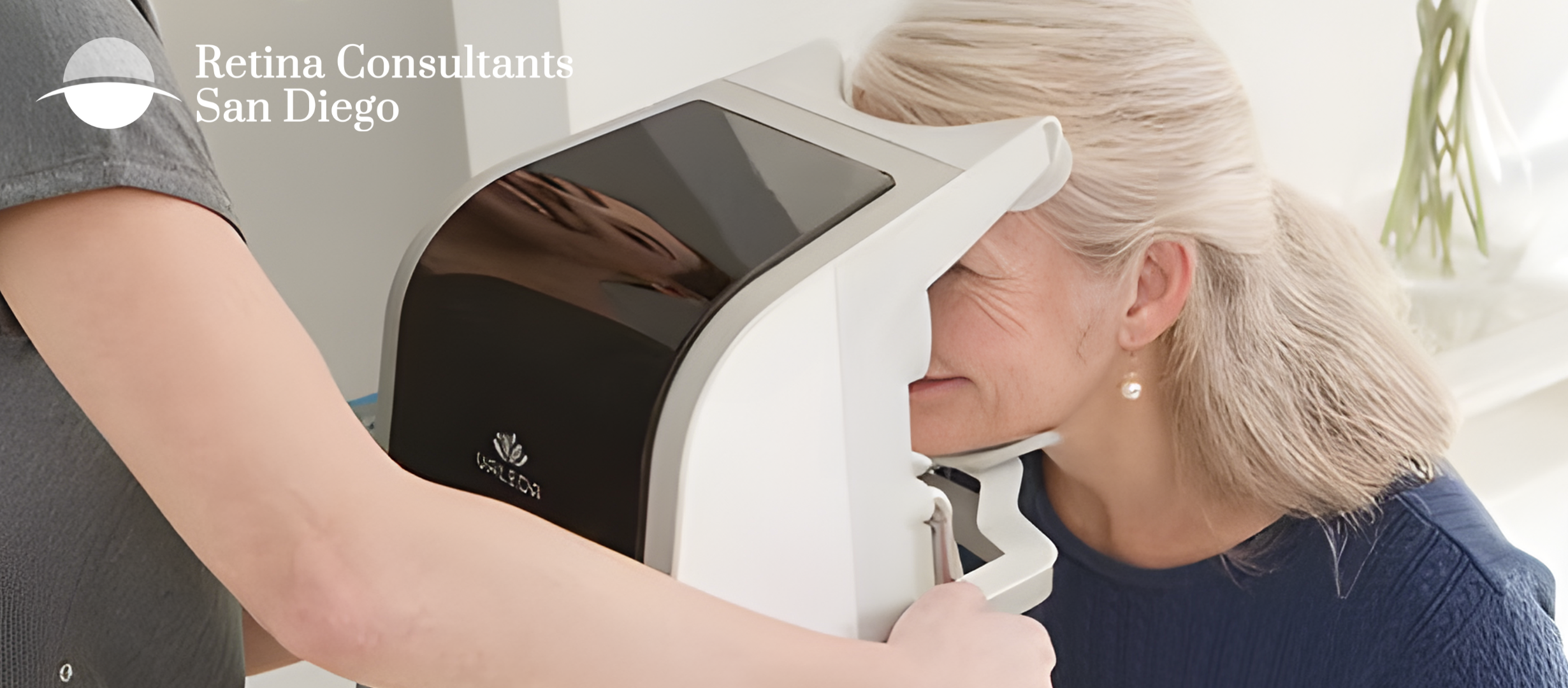
Valeda photobiomodulation changes that for a defined subset of those patients. It is the first light-based therapy authorized by the FDA for dry AMD, and Retina Consultants San Diego was among the first practices in San Diego County to offer it.
Valeda is available at our Poway, Carlsbad, and La Jolla offices.
Use the form below to refer a patient for candidacy evaluation. We will examine and image them, tell you plainly whether they qualify, and send our findings back to your office either way. If a patient is not a candidate, you will get a note explaining why and what we recommended instead.
Refer Your Patient for Valeda Light Therapy
For most of the last two decades, intermediate dry AMD has been a diagnosis without an intervention. AREDS2 supplementation, an Amsler grid, and a recheck in six months has been the whole of what any of us could offer the patient in your chair.
Valeda photobiomodulation changes that for a defined subset of those patients. It is the first and only FDA-authorized photobiomodulation therapy for dry AMD, and the first light-based therapy authorized in the United States for the condition. Retina Consultants San Diego was among the first practices in San Diego County to offer it.
Valeda is available at our Poway, Carlsbad, and La Jolla offices.
Use the form below to refer a patient for candidacy evaluation. We will examine and image them, tell you plainly whether they qualify, and send our findings back to your office either way.
Who to Refer
The authorized indication is narrower than most summaries suggest. Consider referral for patients meeting all of the following:
- BCVA 20/32 to 20/70 in the eye under consideration
- Early to intermediate dry AMD, characterized by at least three medium drusen, one large drusen, or non-central geographic atrophy
- No neovascular maculopathy in that eye
- No center-involving geographic atrophy in that eye
Patients who describe difficulty reading, driving, recognizing faces, or functioning in dim light are the ones most likely to notice a change worth pursuing.
If you are unsure whether a specific patient falls inside the window, send them anyway with a note, or call us first. We would rather have the conversation than have you guess.
How Valeda Works
Valeda delivers non-coherent light at three wavelengths, 590 nm, 660 nm, and 850 nm, to the retina in each session.
The mechanism is mitochondrial. Cytochrome c oxidase, a terminal enzyme in the electron transport chain, absorbs in the red and near-infrared range. Absorption has been associated with increased ATP production, reduced reactive oxygen species, and modulation of pathways related to oxidative stress and inflammation. The multiwavelength approach is intended to engage different depths and different sites in that machinery than a single wavelength would.
The Treatment Course
- Initial series: 9 sessions per eye over 3 to 5 weeks, generally three visits per week
- Repeat series: every 4 months from your first treatment date
- Annual total: 3 series, which comes to 27 treatments per year
- Full program: two years, or 54 treatments
- Treatment duration: approximately 5 minutes per eye
- Session duration: approximately 15 minutes per visit
- What is not involved: no dilation, no drops, no medication, no needles, and no downtime
Safety Profile
Across the clinical program, adverse events occurred at comparable rates in treated and sham groups. There has been no evidence of phototoxicity, no treatment-related serious adverse events, and no meaningful effect on color vision.
The most commonly reported patient experience is a brief afterimage that resolves within seconds.
What We Send Back to You
Patients referred for Valeda evaluation return to you for their routine care. We are not looking to take over the eye.
After the candidacy visit you receive our examination findings, imaging, and treatment plan, with updates as the course progresses. If the patient is not a candidate, you receive a note explaining why and what we recommended instead, which is most often AREDS2 optimization, a defined monitoring interval, or clinical trial screening.
If a referred patient turns out to have occult CNV on imaging, we treat it and notify you promptly.
What Referring Providers Should Know
Valeda is not a breakthrough and we are not going to present it as one.
It is a therapy for selected patients, with a modest average benefit, that requires repeated treatment over two years, and whose benefit may not persist once treatment stops. For the right patient, that is still meaningfully more than watchful waiting, which is what we have had to offer for twenty years.
Refer with that framing and your patients will arrive with expectations we can meet.
Refer a Patient
Complete the form below. Include prior imaging where you have it, which shortens the path to a decision.
To discuss a specific patient before referring, or to ask whether someone is likely to qualify, contact our office at 858-451-1911.